What a Piece of Work Is a Man: Remembering Sir Patrick Stewart
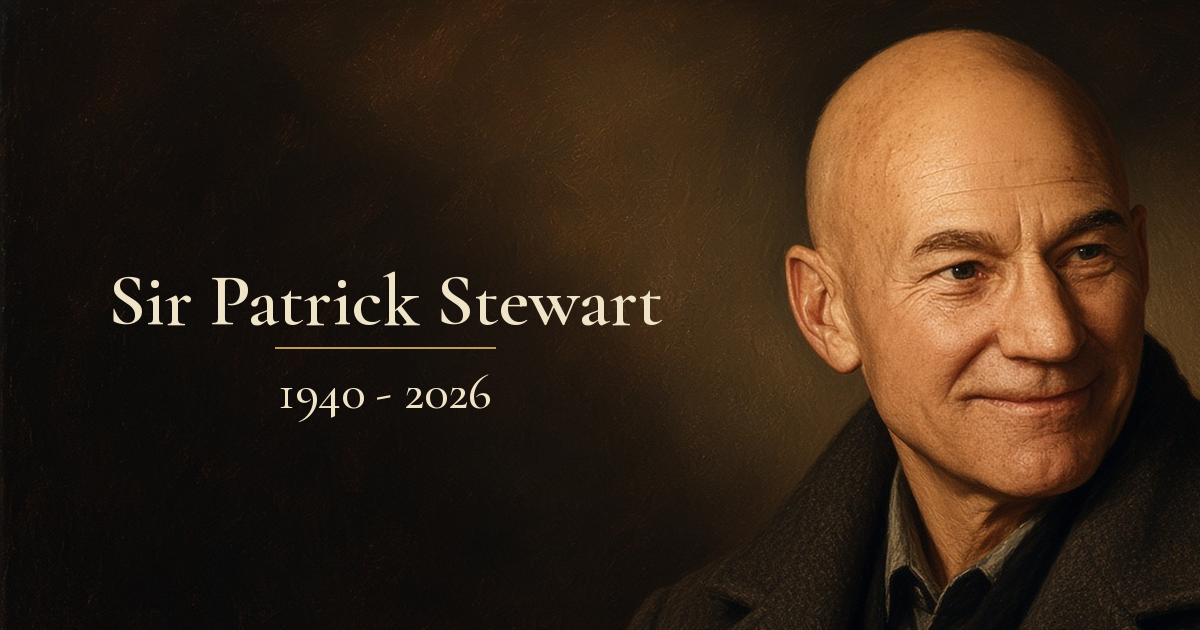
"What a piece of work is a man! How noble in reason, how infinite in faculty... in action how like an angel." Hamlet, Act 2, Scene 2. Shakespeare gave those words to a young prince marveling at what a human being can be. I can think of few people who lived up to them better.
When the news came that Sir Patrick Stewart had died on October 28 at his home in Los Angeles, at 86, after Alzheimer's disease and Lewy body dementia, many people were quick to respond on social media, and I understand why. Grief wants somewhere to go. For me it took a lot longer to process this whole thing. I didn't want to say anything right away. I wanted to sit with it. Some losses arrive like a headline and pass. This one settled in somewhere deeper, the way it does when someone who helped shape you is gone, even if you never shook his hand.
He was an amazing human being. I want to say that plainly before I say anything else. And I believe, without much exaggeration, that he helped raise a generation of young men. He never lectured anyone. He just showed up in our living rooms once a week and was who he was: the diction, the bearing, the class, the dignity, the way he carried himself when the stakes were high and when they were small. A lot of us were paying closer attention than we knew.
A boy from Mirfield
Patrick Stewart was born on July 13, 1940, in Mirfield, a mill town in West Yorkshire. His father, Alfred, was a soldier. His mother, Gladys, worked as a weaver in the textile trade. The house was small and poor. In interviews about his memoir, Making It So, he described a home with no hot running water and no indoor toilet, and a childhood that was good for its first years, until his father came home from the war.
Alfred Stewart came back from France in 1940 changed. In 1945 the local paper, the Mirfield Reporter, wrote that a bomb blast had given him shell shock "from which he still suffers." He went on to serve with distinction in the Parachute Regiment and rose to regimental sergeant major. But the man who came home for good was angry and unpredictable, a drinker on weekends, and he beat his wife. Patrick and his older brother Trevor learned to read the shouting through the door and knew when the violence was coming. Trevor, the taller of the two, would push himself between their father and their mother. Patrick screamed at his father to stop. He later said that he kept it locked inside himself for years, and that he felt shame. It took him, in his own words, "decades of analysis" to "understand and cope with the impact of the violence, fear, shame, and guilt I experienced as a child."
Late in life he came to understand his father differently. Looking into Alfred's war, he concluded that his father had been suffering from what we would now call PTSD, untreated and unspoken, in a time when that kind of wound was treated as weakness. He was careful about this. Understanding his father did not mean excusing him. He spent much of his later life speaking up for survivors of domestic violence and for veterans who needed the kind of help his father never got.
I read those accounts this week with a lump in my throat, because some of that story is mine too. My father carried the Korean War home with him, and our house knew some of what the Stewart house knew. I spent a long stretch of my adult life working through it, in therapy, in the study of attachment theory, and eventually in writing Searching for Bowlby. That book is a historical narrative about John Bowlby, the British psychiatrist who developed attachment theory. Stewart turned his childhood into acting. I turned mine into writing. I'm not putting myself beside him. I mention it because when a man like that tells the truth about where he came from, the rest of us feel free to do the same.
A teacher, a library, and a book of plays
By his own telling, a few ordinary things saved him. The ordinary part is what I keep coming back to.
The first was the library. His family owned only a handful of books. "That was until I found the library," he told The Guardian, "which was critical." He started reading seriously around the age of six, and at about seven he found the Mirfield public library, where the staff were kind to him and showed him where the children's section was. Later he wandered into the adult section and kept going. He called it the most important building in his life. On Saturday mornings he could take two books home and devour them. At home he sometimes read in the outdoor toilet, in warm clothes and a woolly cap, with a candle to keep his hands warm, because it was the one quiet place he had.
I understand that completely. The library was my refuge too, and for some of the same reasons. A certain kind of child learns early that a book is a door you can close behind you, and that on the other side the world is larger and kinder and makes more sense. Some of us never stop being that child.
The second thing was a teacher. At Mirfield Secondary Modern School, an English teacher named Cecil Dormand saw something in this quiet boy who was not doing especially well in class. He put Shakespeare in his hands and encouraged him toward acting. Stewart left school at 15 and worked in local journalism and as a furniture salesman, but he spent his spare hours acting with amateur companies. Decades later, when he was chancellor of the University of Huddersfield, he had the pleasure of presenting Cecil Dormand with an honorary doctorate. I can't think of a better image of what a teacher is worth. The boy he believed in came home a knight and handed the honor back.
The third thing was the voice, and this is where his story touched mine in a way I've only lately been able to name. He grew up speaking broad Yorkshire dialect, thee and thou and all. A drama teacher told him early on that if he wanted to play anything and everything, he would have to learn to speak without an accent. So he learned a second way of speaking and kept it apart from the first, standard English at his lessons and Yorkshire with his friends. He let go of that accent for his career. When he and Michael Parkinson talked about it years later, he said they had toyed with giving Picard a Yorkshire voice, but "it was incomprehensible to the producers."
That work on his speech, and the Shakespearean training that followed, had a real effect on me. Watching him, I learned that a man can speak carefully and still be warm, and that speaking clearly is a way of respecting whoever is listening. A lot of what I later tried to do at the front of a classroom, I first heard in that voice.
From the Royal Shakespeare Company to the bridge
His first professional role came in 1959, as Morgan in Treasure Island at the Theatre Royal in Lincoln, after training at the Bristol Old Vic Theatre School, followed by years of repertory theater in Sheffield, Manchester, and Liverpool. He joined the Royal Shakespeare Company in 1966 and spent a dozen straight years there, in play after play. He was a working actor in the old sense, and he learned his craft the long way.
Then, in 1987, he took a chance on a role he wasn't sure about, the captain of a starship in a syndicated American television show, and became Jean-Luc Picard of Star Trek: The Next Generation. He brought all of that training with him. The Guardian's obituary called his Picard "the show's moral centre and human heart," and I don't think I can improve on that.
It was a TV show. I know that. He had to persevere through invented scripts, some of them better than others. But the best of them put real moral weight on his shoulders, and he carried it in a way that made you believe the questions mattered. He argued that an android crewmate was a person and not property, and he called the alternative by its name: slavery. He stood nearly alone against a respected admiral whose hunt for traitors had turned into a hunt for scapegoats, and he reminded her that "the first time any man's freedom is trodden on, we're all damaged." Tortured and ordered to say he saw five lights when there were four, he refused: "There are four lights!" Then, safe again, he admitted to a friend that he had come very close to breaking. That last part may be the bravest thing the show ever did with him.
Those were the same dilemmas I would meet later in my own life, in different clothes. When do you stand up to authority? How do you treat the person the crowd has decided to fear? What do you do with your own fear? As a history teacher, I recognized them as some of the oldest questions we have. Picard didn't always get the answer right, but he took the questions seriously, and he let us watch him think. Years later, as Charles Xavier in the X-Men films, he played another teacher, another man raising young people who had been told they were dangerous or broken.
Those who help raise us
I think every generation has a few public figures who help raise its young people from a distance. For my father's generation it was men like John Wayne. For an earlier generation of science fiction fans it was the crew of the original Star Trek. None of them were perfect, and none of them replace a father or a mother or a teacher. But when a boy doesn't have a steady model at home, the man he watches on a screen can give him something to build on. He learns what a man sounds like when he is angry and still in control.
I've been asking myself why his death has hit so many men so hard, harder than an actor's death usually does. I think it's because the show had a moral center, and so did he. Picard was strong without being cruel. He used restraint when force would have been easier. He listened before he spoke. He admitted when he was wrong, out loud, in front of the people he led. He led with his conscience, and he was never embarrassed to read a book or quote a poem. For a boy who had only seen strength look like a raised voice or a raised hand, that was a revelation. It said there was another way to be a man, and that it was not the weaker way.
And the man matched the role. Off screen, Stewart spoke openly for years about the violence in his childhood home and lent his name and his voice to survivors of domestic abuse. He became an ambassador for Combat Stress, the British charity for veterans with PTSD, because he had come to understand what his own father had carried and never had help with. He didn't hide where he came from, and he didn't let it make him hard. When men learn that the person they admired on screen was, in the ways that count, the same person in life, admiration turns into something closer to trust. That's why losing him feels like losing a reference point, more than a performer.
Many men who lacked that model at home found it in him, sometimes in nothing more than an hour of television a week. That sounds small until you remember how little some boys have to go on. I think a lot of men felt this loss in the past few days and didn't quite know how to say it.
I've wondered this week why it took me days to process his death. I think it's because he was never only an actor to me. He was proof that a boy from a frightened house could grow into a man of dignity without pretending the fear never happened. He did it with help: a mother who loved him, a brother who stood in the doorway, a library, and a teacher who handed him a book of plays.
Taking command
I taught history for decades. I didn't think of it in these terms at the time, but I do now. He chose to play a man commanding a starship on a TV show. I chose to take command of a classroom and try to help shape a generation. I don't say that with any pride beyond the ordinary pride of a working teacher. I say it because I know where the idea came from. Somewhere in Mirfield, a teacher named Cecil Dormand put Shakespeare in a boy's hands. That small act went out into the world and reached a lot of people, including me. Most of us who teach will never know which of our small acts traveled that far. We do them anyway.
I noticed something this week that I'll mention once and then leave alone. I know it may sound like a stretch, but I couldn't help hearing the word doorman in Dormand: a man who opened a door to another world and ushered a boy from one life into the next. And the boy's name was Stewart, one letter away from steward, and in his turn he ushered a whole generation in, me among them.
The disease that took him at the end is a cruel one for a man who lived by memory, a man who carried thousands of lines of verse in his head, and whose recording of all 154 of Shakespeare's sonnets came out this year. I won't pretend to know what those last months were like. His family said he died in the loving care of his wife, Sunny, "held in the warm embrace of family and friends, surrounded by live music, prayer, tears, laughter." He is survived by Sunny Ozell and by his children, Daniel and Sophie. My thoughts are with them, and with the people of Mirfield, and with his fellow supporters of Huddersfield Town, the club he followed his whole life.
I have lost my wife and my family, so I know a little of the road Sunny, Daniel, and Sophie are on now. The world keeps moving while a house goes quiet, and the hardest days often come after the tributes stop. No one can walk that road for them, but I hope they can feel how many people are walking near it. I hope they are given time, and quiet, and as much kindness as they need.
The family closed their statement with his own words from Making It So, and I'll let them close this too:
"Like me, Jean-Luc has lived an unusual life that has taken him far beyond the bounds of normal human experience. But he is also someone who has remained true to his earthbound roots, for they are what gave him his identity. In the end, he feels the call of home, as do I."
Thank you, Sir Patrick. You taught a lot of us how to speak and how to stand, and how to carry what we came from without letting it carry us. Perhaps somewhere tonight a quiet boy is walking into a library and opening a book of plays, and finding the voice he didn't know he had. Rest well, my captain. You've earned your way home.