The Mother Road: Route 66 and the Psychology of Attachment
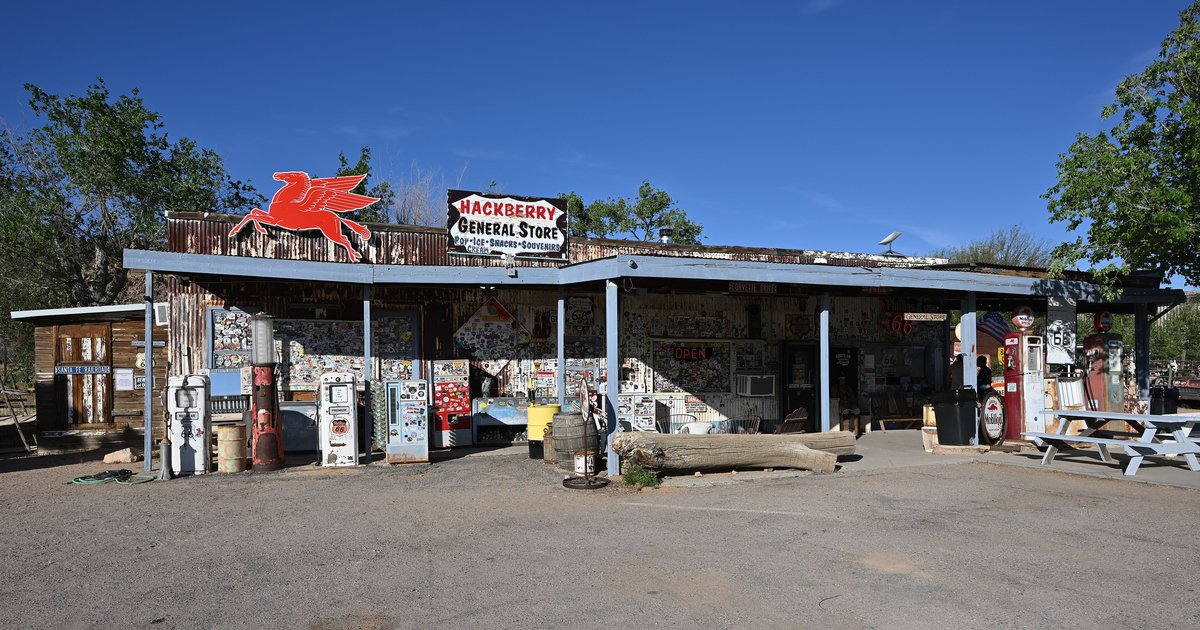
This is Part 3 of a three-part series on Route 66. Part 1, "Why Route 66 and the Mojave Captivate the World," asks why travelers cross oceans to stand on this road. Part 2, "The Demarcation Line," follows the road through the postwar years, the early 1960s, and Mrs. Orcutt's fight for her driveway.
Of all the names people have given this highway, the one that stuck came from a novelist. In The Grapes of Wrath, published in 1939, John Steinbeck wrote that "66 is the path of a people in flight, refugees from dust and shrinking land," and then, a few lines on: "66 is the mother road, the road of flight." Northern Arizona University's Cline Library, which quotes the passage in its Route 66 exhibit, credits the novel and John Ford's 1940 film with fixing the nickname for good.
I have always found it a strange pairing. A mother is the person you run to. A road of flight is the thing you run on. Steinbeck put the two together in one sentence, and I don't think he did it by accident. Over the years I have come to believe that the pairing explains a great deal about why people love this road the way they do, which is not the way anyone loves an interstate. This last part of the series is about that love. It is about attachment.
A place to set out from
The British psychiatrist John Bowlby spent his career on a simple observation: children are not attached to their mothers only because mothers feed them. They are attached because a reliable presence makes the world safe to explore. His colleague Mary Ainsworth gave the idea its best-known form, the "secure base." The developmental psychologist Inge Bretherton, in her history of the origins of attachment theory, traces the concept to Ainsworth: the child ventures out, looks back, and returns, and the adult's steady presence is what makes the venturing possible.
I want to be careful here. Bowlby was writing about children and the people who care for them, not about highways. But he did not draw the circle quite as tightly as people assume. Bretherton quotes a line he wrote in 1959: "for to have a deep attachment for a person (or a place or thing) is to have taken them as the terminating object of our instinctual responses." A person, or a place, or a thing. Bowlby left that door open himself.
Think about what the old road actually offered the people who drove it. It never let you get far from help. The towns came every few miles, and in the Mojave they came because travelers needed water, as I described in Part 1. If your radiator boiled over, there was a gas station that was also a lunch counter that was also somebody's home. You could go far, into country that frightened you, and you were never entirely cut loose. That is a fair description of a secure base. The road was the thing you could venture out on because it would always bring you back.
The cord
This is the image that started this part of the series for me, so let me put it plainly.
Picture the road from above. At one end is Chicago, dense and loud and crowded. At the other end is Los Angeles, the same. Between them lies a long stretch of thinly settled country: the plains, the high desert, the Mojave, with hours of open land between towns. And running through all of it is a single thin line of pavement.
To me that line looks like an umbilical cord. It ties one great center of American life to another, and it carries everything across the empty middle that keeps a traveler alive: fuel, water, food, a bed, a voice at the counter. You can be as alone as you have ever been, out past Amboy with nothing in the mirror, and you are still connected. The cord runs back to the mother culture at either end.
That is why Steinbeck's word fits so well. The Joads were fleeing a home that had failed them, and for the length of the journey the road was what they had to hold on to. It carried them west toward whatever was waiting.
Attachment to place
Environmental psychologists have spent decades studying the bond between people and places. In an influential 2010 paper, Leila Scannell and Robert Gifford proposed that place attachment is best understood as having three parts: a person who is attached, a set of psychological processes (feeling, knowing, and behaving) through which the bond works, and the place itself, both its physical features and its social life.
All three are easy to see along Route 66. The person might be a waitress in Newberry Springs, a German tourist with a guidebook, or a widow on a hundred acres. The processes are the memories, the routines, and the habit of stopping at the same cafe. And the place is not only the asphalt. It is the people you meet along it.
What the research also shows is that when such a bond is broken, people grieve. The classic study is by the psychologist Marc Fried, who interviewed residents of Boston's West End after urban renewal cleared the neighborhood. His 1963 essay "Grieving for a Lost Home" found reactions that looked like mourning: feelings of painful loss, a continued longing, a general depressive tone, helplessness, anger, and a tendency to idealize the place that was gone. The West End Museum, which keeps that neighborhood's memory, notes that the project displaced roughly 2,700 families from 48 acres.
Fried was writing about a city neighborhood and a wrecking ball, not a desert highway and an interstate. But notice the year. His essay appeared in 1963, the same year concrete survey markers appeared on Bonnie Orcutt's land. The country was learning, all at once and in many places, what it costs people to lose the ground they are attached to.
Grief for the bypassed towns
Bowlby's circle studied what happens when a young child is separated from a parent. Bretherton recounts how James Robertson identified three phases of the child's response: protest, then despair, then what he called denial or detachment.
I offer this as an analogy and nothing more. Towns are not children. But when I look at the way the Mother Road's towns met the interstate, I recognize those stages.
First came protest. Bonnie Orcutt's letters to the White House in January 1965 are the example I know best, and as I wrote in Part 2, she asked for very little: "a road on and one off of the present Highway (66)." That is the voice of protest, and it is also the voice of attachment. She was not asking for money. She was asking not to be cut off.
Then came despair. When the new lanes opened, traffic left the old road. Motels emptied, and cafes closed. Some places simply died. The railroad town of Bagdad, the one the cafe would later be named for, was gone after I-40 opened to the north in the early 1970s, as I described in Part 1.
The third stage is where I part ways with the model. Robertson's word was detachment, the point at which the child stops reaching for the parent. Many Route 66 towns never got there. They held on. Newberry Springs kept its name, its people, and its cafe. The Bagdad Cafe still welcomes visitors who walk through its door, even though its kitchen no longer serves food. Up and down the old road, people kept the neon lit and the stories alive long after the traffic was gone. That is not detachment. It is a kind of loyalty that outlasts the reason for it, which is perhaps the truest sign that the bond was real.
Born again on the Mother Road
Steinbeck called 66 the road of flight. For a certain kind of person it was also a road of arrival, and the Mojave stretch was where they arrived as someone new.
In my book Desert Eccentric, I describe the Mojave of the mid-twentieth century as "the great crucible at the end of America's most famous highway," "a place where the Mother Road's promise of a new life was tested against the ancient reality of the wasteland." The book starts from a simpler idea: "The desert has always drawn the people who don't fit anywhere else."
I want to be clear about one word. When I call these people eccentrics, I mean it as praise. An eccentric is someone who lives off the center, and the desert was a place where the center could not reach them. The road brought them out, and the desert gave them room. They did not only take from that room. They gave something back. They were the keepers of the places the rest of us now travel so far to see.
Bonnie Orcutt was one of them. She was a concert-level harpist and a biochemistry student from Indiana who had once taught police recruits to shoot. After her husband died in a plane crash, and after a lawsuit and a slashed car in Manhattan Beach, she started over on a hundred acres east of Newberry. She lived in an Airstream trailer and built an adobe house around it. When the state's survey markers crossed her driveway, the woman who had remade her life in the desert sat down at her typewriter and defended it.
Andrea Pruett was another. In 1995 she and her husband, Harold, bought the Sidewinder Cafe in Newberry Springs and renamed it the Bagdad Cafe. She ran it for three decades, through the death of her son and her husband, through the pandemic, through a fire that took her house, and through a storm that sent water through the old roof. She turned a roadside diner into a place where strangers from France, Germany, and Japan could walk in and feel expected. The kitchen has closed, but the door is still open to visitors. That is what a keeper does.
Bob Waldmire was a third, and he came from the road itself. His father, Ed Waldmire, created the Cozy Dog at a Route 66 drive-in in Springfield, Illinois, as the family's own account records. The son grew into what Route 66 News called "a self-avowed hippie," a vegan who wandered the old highway in a Volkswagen minibus with a solar panel on the roof and "scratched out a living selling his intricate pen-and-ink drawings." For five years he owned the Hackberry General Store on Route 66 in the Arizona desert, and when he eventually sold it, the store kept going as a Route 66 attraction. When Pixar wanted to name the hippie van in Cars after him, he said no, because the toys would have gone out with fast-food hamburgers. He spent his life drawing the road for the people who came to see it. In 2004 he won the John Steinbeck Award for helping to preserve it.
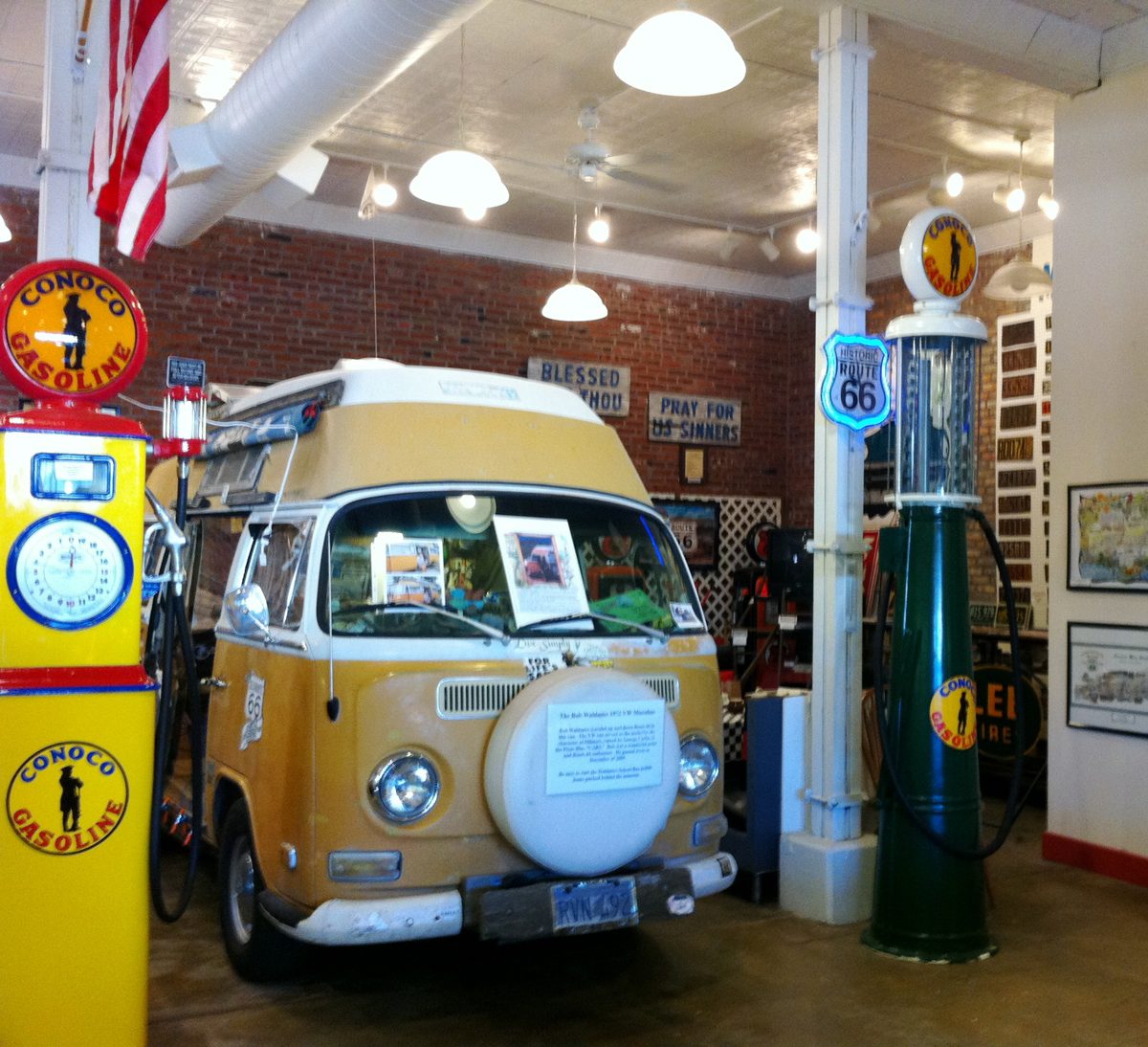
Bob Waldmire's Volkswagen van on display at a Route 66 museum. Photo: Bob Waldmire van at Route 66 Museum.jpg by Anna Harris, CC BY-SA 2.0, via Wikimedia Commons.

What these lives have in common is the pattern I keep returning to in this series. Some arrived after a loss: a death, a scandal, a life that had stopped fitting. All of them found on the old road a place far enough from the center to begin again, and close enough to the traffic to matter. In the language of Part 1 they were reinventing themselves on the frontier. In the language of this part, the Mother Road gave them what a good mother gives a child who does not fit in: a safe place to become who they are. In return, they kept the light on for everyone who came after.
Longing for the past, and for the mother
The word we use for this feeling has its own history. In their 2008 review of nostalgia research, Constantine Sedikides, Tim Wildschut, Jamie Arndt, and Clay Routledge explain that the word combines the Greek nostos, return, and algos, pain. Its roots are in the Odyssey, in a sailor's longing for home. The Swiss physician Johannes Hofer coined the term in 1688 to describe what he saw as a disease. Early writers based their ideas on Swiss mercenaries serving far from home, and for a long time nostalgia was treated as a kind of homesickness.
Homesickness is a child's word. It is what you feel at camp, at night, when you want your mother. I don't think it is a stretch to say that nostalgia for the Mother Road carries some of that same ache. It is a longing for a time, and also for a feeling of being held: a country that felt smaller, slower, and more knowable, where the road always led back to someone who would take you in.
Nostalgia as stored connection
For most of its history, nostalgia was treated as a sickness. Modern research has turned that view around. In Part 1 I described studies showing that nostalgia can raise a person's sense of meaning and social support. One more study belongs in this part, because it ties nostalgia to attachment directly.
In 2010, Tim Wildschut and colleagues published research in the Journal of Personality and Social Psychology titled "Nostalgia as a Repository of Social Connectedness." They found that loneliness could trigger nostalgia, and that nostalgia in turn raised people's feelings of social connectedness. The effect was strongest for people who were comfortable with closeness, those the researchers described as low in attachment avoidance. Nostalgia also raised people's sense that they could offer emotional support to others.
I find that last finding moving. Nostalgia, in this view, is not only about wanting to be held. It is about remembering that we are capable of holding others. When a traveler sits in a desert cafe, listening to a stranger's story and feeling oddly at home, I suspect that is part of what is happening. The road becomes a place to remember connection, and perhaps to practice it.
Borrowed attachment
That leaves the visitors who come from far away. Why would a person who grew up in Munich, Tokyo, or Paris feel attached to an American highway they have never seen?
I think the answer is that their attachment was handed to them, the way a family story is handed down. They grew up with the road in their ears and on their screens. Bobby Troup wrote "(Get Your Kicks on) Route 66" in 1946, and the King Cole Trio recorded it that same year in Los Angeles, according to the song's publication history. In 1964 the Rolling Stones put it on their debut album. In 1988 Depeche Mode took a version into the American charts. From 1960 to 1964, CBS aired a television drama called Route 66 about two young men wandering the country in a Corvette. And as I described in Part 1, Percy Adlon's Bagdad Cafe gave European audiences a story about a German woman who finds a family in a Mojave cafe.
In Part 1 I called this borrowed nostalgia. I now think it runs deeper than nostalgia, and I'd call it borrowed attachment. It is not the same as growing up beside the road. But it is not fake either. A child can love a grandmother's village without having been born there, through the stories, the songs, and the photographs. Many of the travelers who come to Route 66 from abroad are doing something like that. They are visiting the home of a story that was told to them as children, and the road is where that story lives.
The cord still holds
The road turns one hundred on November 11, 2026. It has been bypassed, decommissioned, and written off more than once. Yet people keep coming, from Illinois and from Germany and from Japan, to drive it and to sit in its cafes.
I think they come because the cord still holds. The road ties together places and people across empty country, and it ties us to a version of ourselves that felt more connected. In Bowlby's language, it is a secure base, a place to set out from and return to. In Steinbeck's, it is the mother road. Bonnie Orcutt fought to keep her road on and her road off. In a way, we are all still asking for the same thing: a way back.
If you are just finding this series, Part 1 begins at the Bagdad Cafe, and Part 2 tells how the road became a line between two Americas.
This series draws on my book Mrs. Orcutt's Driveway, the true story of a woman who defended her driveway on old Route 66 east of Newberry when the interstate came through. It is also available on Kindle in French and Spanish. More Route 66 history lives on the book's companion site, mrsorcuttsdriveway.com.
Header image: the Hackberry General Store on Route 66 in Hackberry, Arizona, the store Bob Waldmire once owned. Photo: Hackberry General Store building AZ 2026-04-07 14-23-42.jpg by G. Edward Johnson, CC BY 4.0, via Wikimedia Commons.
