Why Route 66 and the Mojave Captivate the World
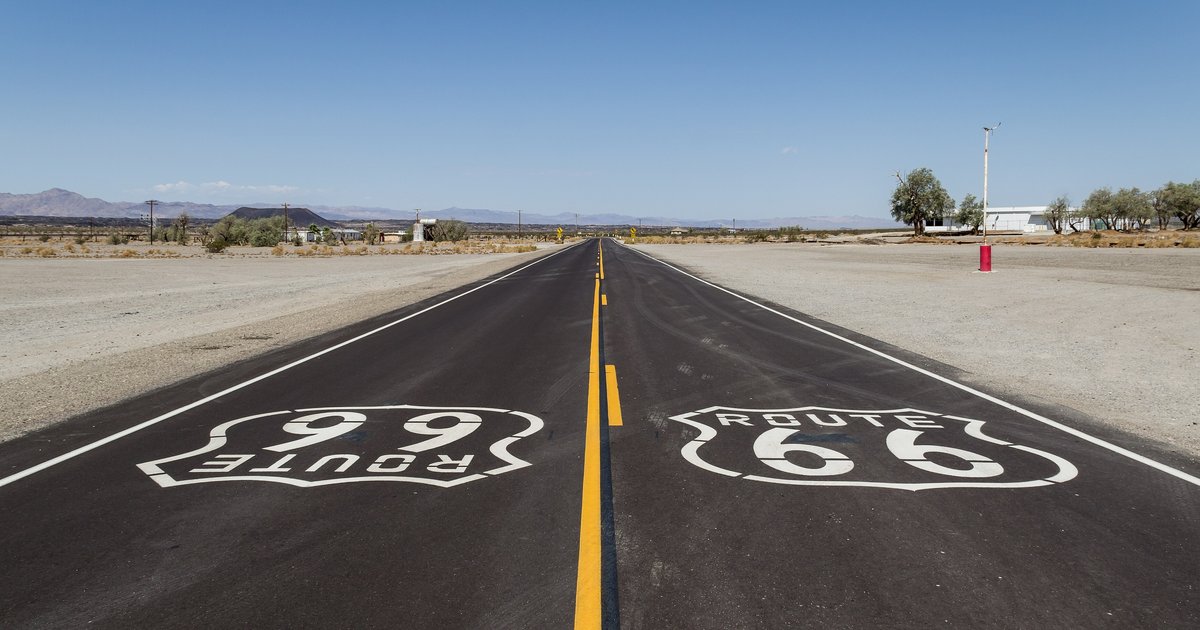
This is Part 1 of a three-part series on Route 66. The pull this road exerts is not just romance; there are real psychological reasons for it, and this series follows them. This part starts with awe, nostalgia, and the desert itself. Part 2, "The Demarcation Line," shows how the road became a line in time between two Americas, and Part 3, "The Mother Road," turns to the deepest reason of all: attachment.
Somewhere east of Barstow, on a stretch of old Route 66 that the interstate left behind half a century ago, a tour bus pulls off the asphalt and stops in front of a small A-frame cafe. The people who climb down have come from France and Germany, from Italy and Japan. The doors are open, but there is nothing to eat: the kitchen closed during the pandemic and never reopened. They go inside anyway. They sign the guest book, look up at the flags hanging from the low ceiling, stand for a while in a room that a German director turned into a fairy tale in 1987, and then they get back on the bus and ride off into the heat.
I want to ask you a plain question about that scene, and I want to resist the plain answer. Why would anyone cross an ocean to stand in a desert cafe that no longer serves food? The plain answer is nostalgia for a simpler time: chrome, neon, a slower America. That answer is not wrong. It is just too small to carry the weight people bring to this road. Something older and stranger is at work out here, and the psychologists, the anthropologists, and the people who run the cafes have each caught a piece of it.
The road that refused to die
Start with the facts, because the facts already contain a paradox. U.S. Highway 66 was born on November 11, 1926, one of the original routes in the new federal highway system, and it ran 2,448 miles from Chicago to Santa Monica. The National Park Service describes it as a cobbling together of existing local, state, and national roads, promoted from the start as the shortest, best, and most scenic way west. In 1939 John Steinbeck gave it the name it still answers to. In The Grapes of Wrath he called it "the mother road, the road of flight," and sent the Joads along it, toward California and across this same desert.
Then the interstates came. Five of them, according to the Park Service, gradually replaced the old highway over three decades. The last original section gave way in October 1984, when Interstate 40 bypassed Williams, Arizona, and in 1985 Route 66 was formally decommissioned. By any reasonable logic that should have been the end of it.
Instead, the opposite happened. When Congress set up a commission for the centennial, the bill's own findings noted that since the road was decommissioned in 1985, its popularity and "mythical stature" had grown, at home and abroad. The road became more famous after it stopped being necessary. Next month, on November 11, it turns one hundred. People are not drawn to Route 66 because it is useful. They are drawn to it because it is not.
A cafe named for a town that isn't there
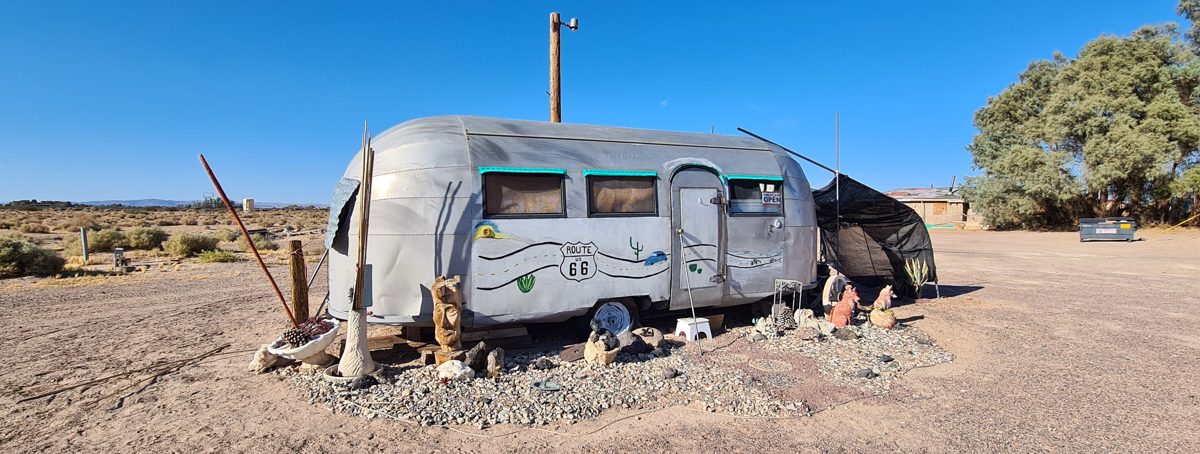
Outside the Bagdad Cafe, Newberry Springs, California. Photo: Newberry Springs Bagdad Cafe route 66.jpg by Guallendra, CC0, via Wikimedia Commons.

The cafe in that opening scene sits at 46548 National Trails Highway in Newberry Springs, California, about 20 miles east of Barstow. For twenty years after it opened in 1975, it was the Sidewinder Cafe. In 1987 the Bavarian director Percy Adlon used it to shoot Bagdad Cafe, released in Germany as Out of Rosenheim, a film about a German tourist named Jasmin who walks away from her husband on a desert highway and stumbles into a run-down truck stop run by a furious, exhausted woman named Brenda. Marianne Sägebrecht played Jasmin, CCH Pounder played Brenda, and Jack Palance played a faded Hollywood set painter who falls for the stranger. Its song, "Calling You," sung by Jevetta Steele and written by Bob Telson, was nominated for an Academy Award.
The real Bagdad was somewhere else entirely. It was a railroad town about fifty miles farther east, named by Southern Pacific officials in the 1880s, a water stop for steam engines and later for cars that limped in overheated off Route 66. When I-40 opened to the north in the early 1970s, Bagdad died. The Los Angeles Times reports that all that remains is a single scruffy cedar tree. On a family road trip along Route 66, Adlon went looking for it. "We saw the name Bagdad on a map," he told The Guardian in 2018, "and we went there and there was nothing: just a few trees and a rundown gas station." So he built his own Bagdad. He wanted the desert to look, in his words, "like a Salvador Dalí painting."
Roger Ebert loved the film and admitted he could not quite say what it meant. Adlon, he wrote, was saying something "about Europe and America, about the old and the new, about the edge of the desert as the edge of the American Dream." In the United States it did respectably for a foreign film. In Europe, Ebert noted, it was one of the biggest box office successes in recent European history, and in France it won the César for best foreign film.
In 1995 Harold and Andrea Pruett bought the Sidewinder and renamed it the Bagdad Cafe. Europeans had already begun to find the place. After the new sign went up, they never really stopped. Pruett told Route 66 News in 2016 that three-quarters of her business came from French-speaking tourists. The walls filled with passport photos and signed dollar bills, and flags from France, Brazil, Japan, New Zealand, and Canada went up under the ceiling. Andrea Pruett ran the place for three decades, through the death of her son and her husband, through the pandemic, through a fire that took her house, and through a tropical storm that sent water pouring through the old roof. She died this past January at 85. Her urn, the Times reports, sits by the front door. The cafe still opens to visitors every day and sells T-shirts and souvenirs; only the kitchen is dark. On a good day it sees three tour buses.
These visitors are making a pilgrimage to a film set that was named for a ghost town, in a desert that the film itself painted in colors it does not have. What are they actually looking for?
Man against the desert, and the comfort of consequence
The oldest answer is the simplest one. The Mojave is not interested in you. On the summer morning the Times reporter visited the Bagdad Cafe, it was already 115 degrees outside. The town of Bagdad existed at all because steam engines needed water every eight miles or so out here, and because cars overheated so often that a cafe could make a living on the travelers who coasted in.
That struggle is the backbone of the Route 66 story. Steinbeck's migrants crossed this country carrying everything they owned. The motels and gas stations were not quaint. They were survival infrastructure, the difference between arriving and not.
I think part of the draw is how sharply this cuts against ordinary modern life. Most of us live in climate-controlled rooms, travel in sealed cars along roads engineered to erase the terrain, and move through days in which almost nothing we do has an immediate physical consequence. The desert reintroduces consequence. Run out of water and it matters. Break down and it matters. That is frightening, and it is also oddly clarifying. People pay a surprising amount to feel that again.
Vastness and the shrinking self
The psychologists have a name for what happens next. In 2003 Dacher Keltner and Jonathan Haidt published an influential paper on awe, arguing that it rests on two things: a perception of vastness, and a need for accommodation, meaning the experience is too big to fit the mental structures you walked in with. Keltner later put it more simply. Awe, he wrote, "is the feeling of being in the presence of something vast that transcends your understanding of the world." He traces the modern study of it back to Edmund Burke's 1757 treatise on the sublime, which located that overwhelming feeling not only in religion but in thunder, music, and the play of light and dark.
The desert is close to a pure delivery system for vastness. The horizon is the horizon.
What awe does to people is the interesting part. In a 2015 study led by Paul Piff, participants who spent just one minute looking up at a grove of towering eucalyptus trees later helped a stranger pick up more dropped pens than people who spent that minute looking at a tall building, and they reported feeling less entitled. The researchers tied the effect to what they called the "small self," a sense that you are a modest part of something larger. A 2017 study by Yang Bai and colleagues found the same shrinking in the field. Tourists at Yosemite drew themselves smaller than tourists at Fisherman's Wharf in San Francisco, a sign of how much the landscape had rearranged their sense of scale.
The smallness people feel in the Mojave is not humiliating. For most of them it is a relief. The usual self, with its inbox and its grievances and its performance reviews, gets temporarily outsized by the land, and something kinder moves into the space it leaves.
The interstate is a non-place
Here is a distinction I find useful. In 1992 the French anthropologist Marc Augé wrote a short book called Non-Places. He argued that modern life is increasingly lived in spaces of circulation, consumption, and communication: airports, supermarkets, hotel chains, motorways. A non-place is a space you pass through without belonging to.
Interstate 40 is a near-perfect non-place. It is built for speed and sameness.
Old Route 66, running alongside it, is the opposite. It is what Augé would call a place in the anthropological sense, a space with history and relationships folded into it, where a particular woman kept a particular jukebox stuck on one song and greeted busloads of strangers in French and German. When a European traveler leaves the interstate for the old road, she is not only changing highways. She is stepping out of the non-places that fill most of modern life and back into somewhere that has a memory. I suspect a good deal of the pilgrimage is exactly that: a walk from the generic to the particular.
The old road also has a quality anthropologists call liminality, the in-between state of a threshold, the middle stage of a rite of passage in which you are no longer what you were and not yet what you will become. A desert highway is a long threshold. Nothing much is supposed to happen there except the passage itself.
Leaving yourself at the side of the road
Watch how Bagdad Cafe opens. Jasmin and her husband argue in the desert, she gets out of the car with a suitcase, and he drives away. The suitcase turns out to be his. Brenda goes through it and finds only men's clothes. In the first minutes of the film the stranger loses her husband, her car, her plans, and even her wardrobe. Everything that told the world who she was has been left on the shoulder of Route 66.
That stripping away is one of the deepest things the desert offers, and it is also one of the most frightening. Solitude researchers have found real benefits in being alone. Christopher Long and James Averill described how solitude can open room for freedom, creativity, intimacy, and spirituality. A set of experiments by Thuy-vy Nguyen, Richard Ryan, and Edward Deci found that time alone tends to quiet high-arousal feelings, both good and bad, and that when people actively chose to be alone, it led to relaxation and lower stress.
But there is a darker finding beside it. In 2014 Timothy Wilson and his colleagues asked people to sit alone in a room with nothing to do but think for 6 to 15 minutes. Most did not enjoy it, and many chose to give themselves a mild electric shock rather than sit with their own thoughts.
That tension sits at the center of the desert road. The road is a symbol of freedom: no boss, no schedule, no one who knows your history. It is also a confrontation with the void, with the long empty miles in which nothing distracts you from yourself. Route 66 holds both. The pull of the Mojave, I think, is that it lets you get close to the edge of that emptiness and feel what happens to you there, with a cafe waiting around the bend to bring you back.
Why open country feels like rest
There is a gentler version of the same idea. Environmental psychologists Rachel and Stephen Kaplan developed what is known as attention restoration theory. In a 1995 paper Stephen Kaplan argued that the focused, effortful attention modern life demands wears down, and that certain environments help it recover. The ingredients include a sense of being away, a sense of extent, and "soft fascination", the kind of gentle interest that clouds or moving water hold without demanding anything back.
I should be honest about a limit here. Most of the restoration research has studied green places: parks, forests, gardens. I have not found strong evidence that a desert does the same work in the same way, and I would not claim it does. But "extent" is the desert's specialty. Few landscapes make you feel more thoroughly away.
The frontier that closed, and the road that kept it open
In the summer of 1893, at the World's Columbian Exposition in Chicago, a young historian named Frederick Jackson Turner delivered a paper arguing that the frontier had shaped the American character, and that, according to the census of 1890, the frontier was now gone. Historians have argued with him ever since. His frontier left out the people who already lived on the land. But the idea he named, of a West where a person could go to start over, never lost its grip on the national imagination.
Thirty-three years later a new federal highway started in that same city and pointed west. When Congress authorized the Park Service to study Route 66 in 1990, it described the road as a symbol of "the American people's heritage of travel and their legacy of seeking a better life." That is the frontier myth, reissued on asphalt. The road kept the possibility of reinvention open long after the frontier itself had closed.
Bagdad Cafe is a reinvention story too, and the effect on audiences was real. CCH Pounder told The Guardian that she received letters day in and day out from viewers who wanted to leave the corporate world and reawaken their creative lives. When they saw the film, she said, they told her: "I'm gonna do it." A film about a lonely woman remaking herself at a desert truck stop sent strangers back to their own lives with permission to change them.
Nostalgia for a past you never had
Now back to nostalgia, because the research on it is far more interesting than the clichés. For a long time nostalgia was treated as a kind of homesickness, even a disorder. Constantine Sedikides, Tim Wildschut, and their colleagues have spent two decades showing that it does something else. In a 2006 series of studies they found that nostalgic memories tend to star the self surrounded by close others, and that thinking nostalgically raised positive mood, self-regard, and feelings of social connection. Loneliness and low mood were among its most common triggers. A 2008 study led by Xinyue Zhou found that nostalgia helps counteract loneliness by increasing the sense that one has people to lean on. A 2011 paper by Clay Routledge and colleagues found that nostalgia makes life feel more meaningful and can buffer threats to meaning.
Here is the strange part about Route 66. Many of the people who feel its nostalgic pull never lived its history. A young visitor from Lyon or Osaka cannot remember the road's heyday. What they remember is the films, the songs, the photographs, and perhaps a childhood evening watching a German housewife do magic tricks in a Mojave truck stop. Call it borrowed nostalgia. The neon motel signs, the old gas pumps, the guest books full of handwriting in a dozen languages are a kind of machine for producing the social warmth the research describes. You stand among the traces of thousands of other strangers who came here for the same reason, and you feel, briefly, that you belong to them.
The pleasure of ruins
Not everything along the road has been restored. Plenty of it is falling down: empty motor courts, gas stations with no pumps, signs with no businesses behind them.
People have taken pleasure in ruins for centuries. In 2014 Tate Britain mounted an exhibition called Ruin Lust, curated by the writer Brian Dillon, that traced what it called the "mournful, thrilling, comic and perverse" uses of ruins in art from the seventeenth century to the present, beginning with the eighteenth-century craze in which painters such as Turner and Constable toured Britain in search of ruins. The exhibition notes describe artists who saw ruins as "zones of pure potential, where the world must be rebuilt or reimagined."
That phrase explains a lot about a ruined motel in the Mojave. A ruin is time made visible. It tells you that the confident, prosperous world that built it did not last, which is melancholy, and it hands you an unfinished story to complete in your head, which is pleasure. Many Europeans grow up among castle walls and churches rebuilt after the war, and they often seem especially fluent in this mode.
The America they came looking for
Why do Europeans in particular make the trip? Part of the answer is that many of them were prepared for it in childhood. In Germany the novelist Karl May wrote more than thirty adventure books about the American West, featuring the Apache hero Winnetou and his German blood brother Old Shatterhand. His books sold some 200 million copies worldwide and were adapted into popular West German films in the 1960s. May, as JSTOR Daily notes, never traveled west of Buffalo, New York. His West was a dream, and a dream with real problems of stereotype. But generations of Germans grew up inside it. Buffalo Bill's Wild West show first toured Germany in 1890.
European filmmakers kept returning to the American desert to tell stories about drift and longing. Wim Wenders made Paris, Texas, which won the Palme d'Or at Cannes in 1984. The French philosopher Jean Baudrillard drove across the West and wrote America, in which the desert becomes a key to the whole country.
When a traveler from Europe says she wants to see "the real America," she usually does not mean New York or Los Angeles. She means the America she was promised in those books and films: open, empty, a little dangerous, populated by eccentrics. The Mojave stretch of Route 66 is one of the few places where that promise still looks roughly like the picture. It is worth saying, gently, that the "real America" a visitor finds there is partly a projection, built from Karl May and Wenders and Adlon's Dalí colors.
The pull is not only European. The Los Angeles Times notes that Bagdad Cafe captivated viewers in Japan as well. A Route 66 Association of Japan was founded in 2015, and in 2023 an all-female chindon'ya street band from Aichi called Bentenya spent 17 days traveling Route 66 for a documentary meant to build ties between the two countries before the centennial. I would not presume to explain what the road means to each of those travelers. It is enough to notice that its pull crosses the Pacific as easily as the Atlantic.
Found family at the end of the world
Which brings me back to the cafe, and to what I think is the deepest reason the film still pulls people across oceans. Bagdad Cafe is a story about found family. A stranded German woman and a worn-out Black American woman who start as near enemies end up building a family out of a collection of misfits: Brenda's children, a tattoo artist, an aging painter, truckers, a Native American sheriff. When Jasmin's visa runs out and she has to leave, the magic leaves with her. When she comes back, it returns.
The desert sharpens that story because it raises the stakes of belonging. Out here, isolation can be dangerous, so a community is worth more. Pounder told The Guardian that the film moved her because "for the first time we saw a female in charge of something," particularly a woman of color. The film's family is built by women, across language, race, and nationality, at the end of a road that most people only drive through.
The real cafe seems to have lived out a version of the same story. The Los Angeles Times tells of a night in the 1990s when a man came in and tried to rob Andrea Pruett with a board. She pulled a shotgun from under the counter. He said his family was in the car, out of money. She brought them inside, fed them, gave them some cash, and made them wash their own dishes. Her grandson described her as "kind almost to a fault," someone who gave work and a place to stay to people nearly everyone else had given up on. In her last years, when she could no longer run the place, desert neighbors stepped in to look after her and the cafe.
That is the story under the story, and I think the travelers sense it even when they cannot name it. They come for the movie. What they find is a room that strangers kept alive for strangers.
A driveway east of Newberry
There is another woman whose story belongs to this same stretch of road. Her name was Margaret "Bonnie" Orcutt. She was born in Boone County, Indiana, in 1909 and was a concert harpist before she came to the Mojave. Then, in the words of the book's description, tragedy struck, and then struck again. She settled on 100 acres east of Newberry, lived in an Airstream, and built an adobe house by hand. A neighbor remembered her as "a tiny thing, probably four feet seven. A real pistol."
Then the surveyors came for the interstate, and the road that connected her home to the world was about to be cut off. On January 13, 1965, she wrote to Lady Bird Johnson: "I only want what I have at present: a road on and one off of the present Highway (66)."
Her story holds nearly everything I have tried to describe here. A small human figure against an enormous landscape. A stubborn argument with an indifferent force, in her case not the desert but the bureaucracy of progress. A place on the old road that someone refused to let become a non-place. I told her story in a book called Mrs. Orcutt's Driveway. If what you have read here interests you, you might find her worth knowing. One request, if you do go out that way: the land is private. The road is the place to visit, and the cafe, and the long view east. The driveway belongs to her story.
What the bus is really carrying
Go back to that tour bus outside the Bagdad Cafe. The people on it are not only nostalgic for an America of chrome and neon. They are looking for vastness that makes them small in a good way. They are stepping out of the non-places of their ordinary lives into somewhere with a memory. They are testing themselves, briefly, against an emptiness that is both freedom and void. They are taking a borrowed nostalgia and using it, the way the research says nostalgia is used, to feel connected to other people.
And at the end of all that, they want what Jasmin wanted when she walked out of the desert with the wrong suitcase. They want to find out that a stranger can arrive at the edge of the world and be taken in.
The road turns one hundred next month. The cafe, still open to anyone who walks through the door, is waiting to learn what comes next. The desert, as always, does not care. That indifference may be the very thing that makes all the human kindness along Route 66 so visible, and so worth crossing an ocean to see.
The fascination with this road has real psychological reasons, and this essay has only begun to name them. The series continues in Part 2, "The Demarcation Line," on the early 1960s, the interstate, and the line the road drew through time, and in Part 3, "The Mother Road," on why people grow attached to a highway the way they grow attached to a home.
This series draws on my book Mrs. Orcutt's Driveway, the true story of a woman who defended her driveway on old Route 66 east of Newberry when the interstate came through. It is also available on Kindle in French and Spanish. More Route 66 history lives on the book's companion site, mrsorcuttsdriveway.com.
Header image: Route 66 shields painted on the old road near Amboy, California. Photo: Amboy (California, USA), Hist. Route 66 -- 2012 -- 1.jpg by Dietmar Rabich, CC BY-SA 4.0, via Wikimedia Commons.
,_Hist._Route_66_--_2012_--_1.jpg)